
Jesus: the Master of the Subtle Warning

In Luke 4, Jesus is preaching in his hometown of Nazareth.  I guess one might say it didn’t go well—seeing as they wanted to throw him off the cliff when he finished preaching.  As part of his response to their unbelief, Jesus repeats two familiar stories:  Elijah and the foreign widow of Zarephath and Elisha and Naaman the leper.  What?  Why these stories?  The context is unbelief and rejection of Jesus.  Jesus chose the stories in a strategic manner.  First of all, the drought of the Elijah story was three years and six months, and it occurred during the apostasy of King Ahab.  Perhaps Jesus is connecting the dots and bringing the story forward to the present, i.e., their unbelief and apostasy.  Interestingly, he specifically mentions the numbers making up the drought even though the length isn’t obviously relevant (though numbers in the Bible often have symbolic meanings); consequently, the divine choice for the duration of the drought may be purposeful–three is the number of God and six is the number of man.  In Elijah’s story, the three years and six months may speak symbolically of apostate man’s struggle with God.  What is God’s response?  He sends Elijah to the gentiles, and Jesus rams home the idea by following it with God’s positive dealings with another gentile, Naaman.  The subtle warning to the Israelites:  believe in God, change your ways or God will send the gospel to the gentiles who will receive it with joy.  This might be a good warning to American Christians lest we fall into the same trap as these Israelites who believed that they were protected by their heritage…just sayin’
Lee Burrows on ‘Gods of Egypt’

Why is the Christian Life So Hard?

St. Paul commands us in Colossians 3:1 to “seek the things that are above, where Christ is, seated at the right hand of God.”  In this context, to “seek” does not mean to ignore or withdraw from the world.  Rather, just as Moses was to follow the heavenly pattern he received on Mt. Sinai for making the holy items, so we are to follow the heavenly pattern as set forth and demonstrated by Jesus Christ.  What does this look like?  Verses 12 and 13 paint a clear picture of the “holy items” that adorn the imitation of Christ:  “compassionate hearts, kindness, humility, meekness and patience, bearing with one another and, if one has a complaint against another, forgiving each other…”  This is what kingdom living looks like.  The question I have for myself is:  “why is it so hard?  Why do I fail so often?”  Christianity is not for cowards…just sayin’

A Thought on how the Bible Comments on Itself

I have often wondered about the story in Genesis 4 where Cain and Abel are bringing their offerings to God.  As the story goes, Cain’s offering was rejected by God and Abel’s was received favorably.  The Bible does not specify why one offering was received and the other rejected.  We are left to ponder the reason.  I have my own thinking on this issue and it is tied to the idea of Abel bringing “the firstborn of his flock” while Cain’s “fruit of the ground” doesn’t carry a similar idea, i.e., first fruits.  Thus, there appears to be a qualitative difference in the offerings, which speaks to the state of their respective hearts.  With this in mind, it occurred to me while reading Deuteronomy 26 this morning that there is a connection with Genesis 4 and the idea that “first fruits” expresses the state of one’s heart.  Moses commands the people to “take some of the first of all the fruit of the ground…and you shall put it in a basket, and you shall go to the place that the Lord your God will choose…and you shall go to the priest…then the priest shall take the basket from your hand and set it down before the altar of the Lord your God.”  The implication here is that taking the first fruits of the land shows the Israelite’s gratitude for the grace of God, which, apparently, Cain did not have…just sayin’

Are We Obsessed With Order and Precision?

The culture of modern man is obsessed with precision so much so that we are able to measure microscopic organisms—things we cannot even see!  And oh how we love to reduce our equations to the lowest common denominator, and, of course, we like to measure our time with atomic clocks (accurate to within one second in 30 million years—now we’re talkin’).  Is it possible that our obsession with precision and order might have theological ramifications?  The thought occurred to me this morning that this obsession with order and precision might be an idol, a false god.  How so?  While pondering the sacrament of baptism and the process of salvation, I was going over some of the arguments about the order of salvation.  Is it simply a matter of hearing the gospel and making a decision?  Does belief “cause” man to be born again?  And if so, how does a man, who is dead in his trespasses and sins, come to believe in the first place?  Some would say that God enlivens (causes to be born again) the otherwise dead man who subsequently hears the gospel and believes unto salvation…in spite of my personal opinions about this, I realize that at some level I am making an idol of order and robbing God of the glory surrounding his miracle of salvation.  I love theology (and empirical thought) but maybe we should pause, take a breath and simply “bow our knee” to the mystery of such things as the order of salvation and let God be God…just sayin’

Jesus, the Bread of Life

It has been said that the Old Testament is Christ concealed and the New Testament is Christ revealed.  An example of this occurs in Exodus 25:30 where Yahweh commands that “you shall set the bread of the Presence on the table before me regularly.”  Yahweh didn’t command this because He was hungry!  No, He required that this bread be set in the Holy Place before the veil so as to be an object lesson, an object lesson consisting of twelve loaves of bread—one for each of the twelve tribes of Israel. There is a plethora of symbolism here. For example, just as bread is a tangible thing, so Jesus would take on flesh.  In fact, the twelve loaves symbolize that Jesus would be born into the tribes of Israel. Also, as bread nourishes the body, so Jesus, the bread of life, nourishes the soul, and finally, while the bread of the Presence is only to be eaten by the priests, the bread representing the body of Christ in Holy Communion is only to be eaten by baptized believers–a priestly caste.  Food for thought…just sayin’


Can Art be Christian?

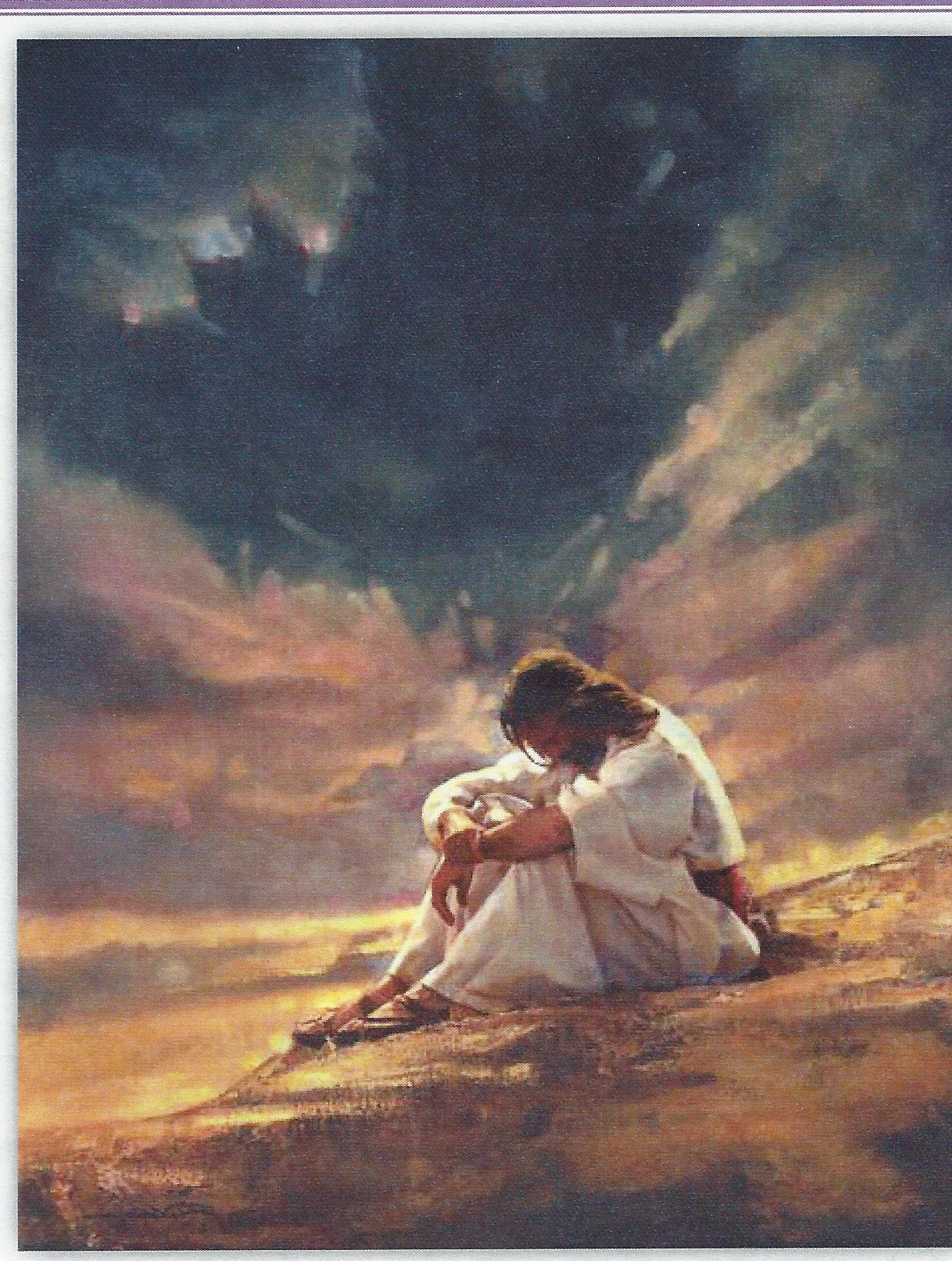
Some Christians scoff at art, but is that wise? Isn’t God the author of all things good? Might our minds be changed if we see the subtle truth hidden in the beauty of art? In church this morning, the readings included a passage from the gospels on the temptation of Jesus in the wilderness. We are generally familiar with this passage and we sometimes “speed read” though it; however, the bulletin this morning caught my eye. On the cover was a beautiful work of art. A person that is intended to be Jesus is sitting by himself in the wilderness. I suppose this could be Jesus at prayer, but wait…what is that portrayed by the artist just over Jesus’ head? At first blush, it appears to be a dark cloud amidst a glorious sunrise; however, upon closer observation, the dark cloud takes on the shape of a bat. Might this be the artist’s foreshadowing of the looming temptation of Jesus by Satan? The artist has wonderfully suggested to us in a simple picture the gravity of the situation that Jesus finds himself. Maybe art does have a place in the Christian world…just sayin’
The Temptation of Christ

The Mystery of Christian Circumcision

Colossians chapter 2 is full of mystery–just not the “who done it” type.  It deals with the mystery of how Christians are circumcised.  Circumcised?  Isn’t that Old Testament stuff?  No, it is definitely New Testament, as verse 11 makes clear:  In him also you were circumcised with a circumcision made without hands, by putting off the body of the flesh, by the circumcision of Christ.”  Whereas the circumcision of the Old Testament includes putting off a small portion of the flesh, the New Testament circumcision requires a “putting off [of] the body of the flesh”–the whole body.  Thus, New Testament circumcision is an all-encompassing proposition for us.  The mystery deepens as verse 12 links it to our baptism and our being raised with Christ.  Suffice it to say that there is way more going on in our salvation than meets the eye…just sayin’.

Strengthened with All Power

I was reading Colossians chapter one this morning, and when I read verse 11, I stopped as it occurred to me that “May you be strengthened with all power” is a wondrous statement.  Who doesn’t wish to be filled with “all power”?  I realized that, at first blush, this verse is apt to confuse.  Sadly, when I think of power, I think of the miraculous.  But is that what this is about?  No, St. Paul is praying for them to receive power, not for miracles, signs and wonders, but for “endurance and patience.”  As I paused to consider this, I realized that this is a great message for 21st century American Christians who are rich and comfortable.  Maybe the lack of power in the American church is directly related to this.  It seems that “all endurance and patience” is needed for those who are suffering and struggling.  For 21st century American church folk, St. Paul appears to be using a non-sequitur when he conflates “endurance and patience” with “joy.”  Maybe St. Paul is on to something…just sayin’