The Anglical Account
Lee’s news, daily devotionals, and general musings about the world through liturgical eyes.

It has been said that the Old Testament is Christ concealed and the New Testament is Christ revealed. An example of this occurs in Exodus 25:30 where Yahweh commands that “you shall set the bread of the Presence on the table before me regularly.” Yahweh didn’t command this because He was hungry! No, He required that this bread be set in the Holy Place before the veil so as to be an object lesson, an object lesson consisting of twelve loaves of bread—one for each of the twelve tribes of Israel. There is a plethora of symbolism here. For example, just as bread is a tangible thing, so Jesus would take on flesh. In fact, the twelve loaves symbolize that Jesus would be born into the tribes of Israel. Also, as bread nourishes the body, so Jesus, the bread of life, nourishes the soul, and finally, while the bread of the Presence is only to be eaten by the priests, the bread representing the body of Christ in Holy Communion is only to be eaten by baptized believers–a priestly caste. Food for thought…just sayin’
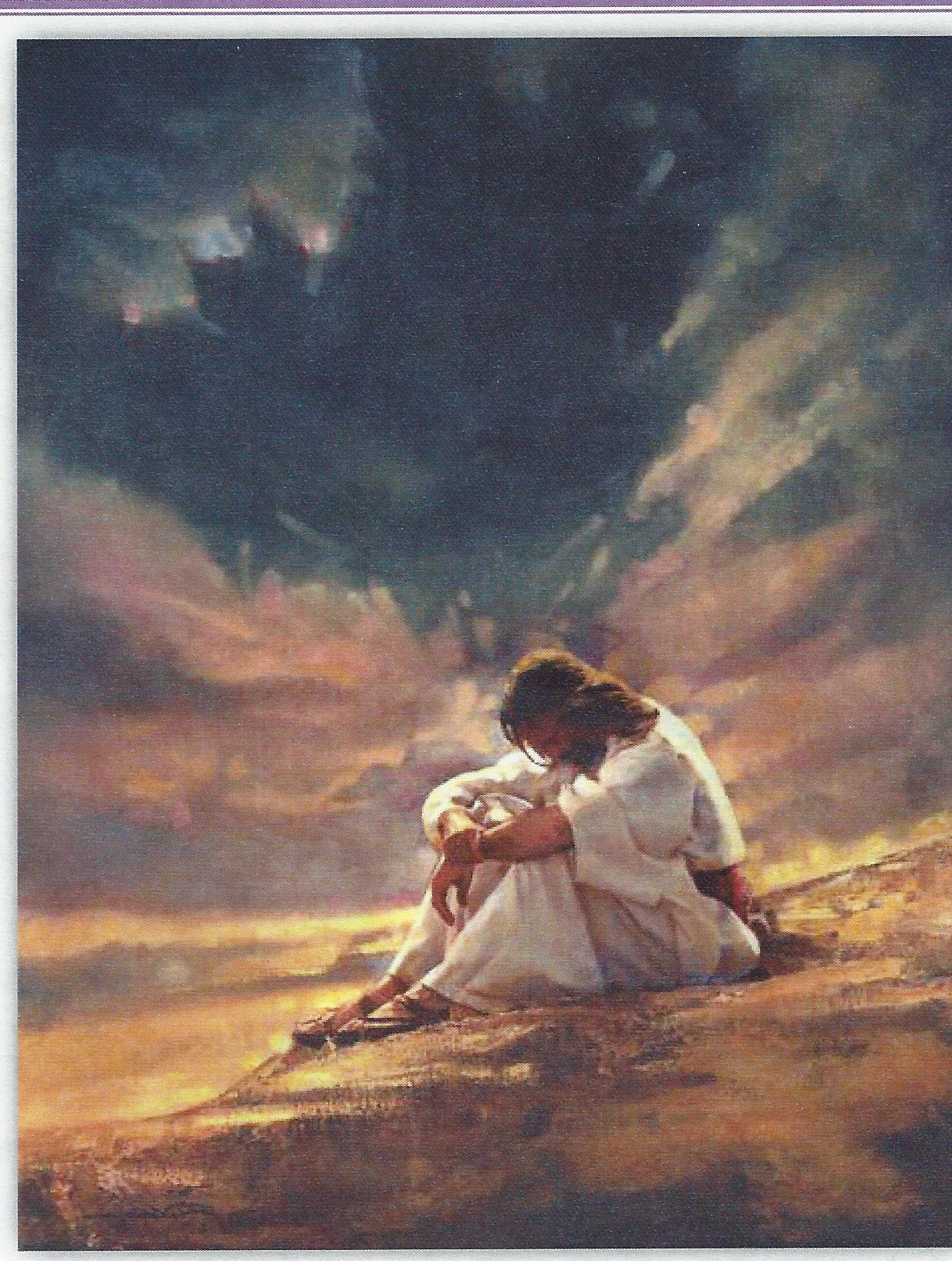
Some Christians scoff at art, but is that wise? Isn’t God the author of all things good? Might our minds be changed if we see the subtle truth hidden in the beauty of art? In church this morning, the readings included a passage from the gospels on the temptation of Jesus in the wilderness. We are generally familiar with this passage and we sometimes “speed read” though it; however, the bulletin this morning caught my eye. On the cover was a beautiful work of art. A person that is intended to be Jesus is sitting by himself in the wilderness. I suppose this could be Jesus at prayer, but wait…what is that portrayed by the artist just over Jesus’ head? At first blush, it appears to be a dark cloud amidst a glorious sunrise; however, upon closer observation, the dark cloud takes on the shape of a bat. Might this be the artist’s foreshadowing of the looming temptation of Jesus by Satan? The artist has wonderfully suggested to us in a simple picture the gravity of the situation that Jesus finds himself. Maybe art does have a place in the Christian world…just sayin’
Colossians chapter 2 is full of mystery–just not the “who done it” type. It deals with the mystery of how Christians are circumcised. Circumcised? Isn’t that Old Testament stuff? No, it is definitely New Testament, as verse 11 makes clear: In him also you were circumcised with a circumcision made without hands, by putting off the body of the flesh, by the circumcision of Christ.” Whereas the circumcision of the Old Testament includes putting off a small portion of the flesh, the New Testament circumcision requires a “putting off [of] the body of the flesh”–the whole body. Thus, New Testament circumcision is an all-encompassing proposition for us. The mystery deepens as verse 12 links it to our baptism and our being raised with Christ. Suffice it to say that there is way more going on in our salvation than meets the eye…just sayin’.
I was reading Colossians chapter one this morning, and when I read verse 11, I stopped as it occurred to me that “May you be strengthened with all power” is a wondrous statement. Who doesn’t wish to be filled with “all power”? I realized that, at first blush, this verse is apt to confuse. Sadly, when I think of power, I think of the miraculous. But is that what this is about? No, St. Paul is praying for them to receive power, not for miracles, signs and wonders, but for “endurance and patience.” As I paused to consider this, I realized that this is a great message for 21st century American Christians who are rich and comfortable. Maybe the lack of power in the American church is directly related to this. It seems that “all endurance and patience” is needed for those who are suffering and struggling. For 21st century American church folk, St. Paul appears to be using a non-sequitur when he conflates “endurance and patience” with “joy.” Maybe St. Paul is on to something…just sayin’
 Biblical Archaeology in Five and the Golden Calf IncidentJuly 1, 2020 - 2:45 pm
 Biblical Archaeology in Five: Why doesn’t Moses give us the name of the Pharaoh in the Exodus?June 8, 2020 - 5:59 pm
 Biblical Archaeology in Five on Exodus 14 and the Parting of the Red SeaMay 6, 2020 - 5:14 pmBiblical Archaeology in Five and the Golden Calf IncidentJuly 1, 2020 - 2:45 pmBiblical Archaeology in Five: Why doesn’t Moses give us the name of the Pharaoh in the Exodus?June 8, 2020 - 5:59 pmBiblical Archaeology in Five on Exodus 14 and the Parting of the Red SeaMay 6, 2020 - 5:14 pm
 “Father, forgive them”–A Radical IdeaJune 20, 2019 - 2:53 pm